
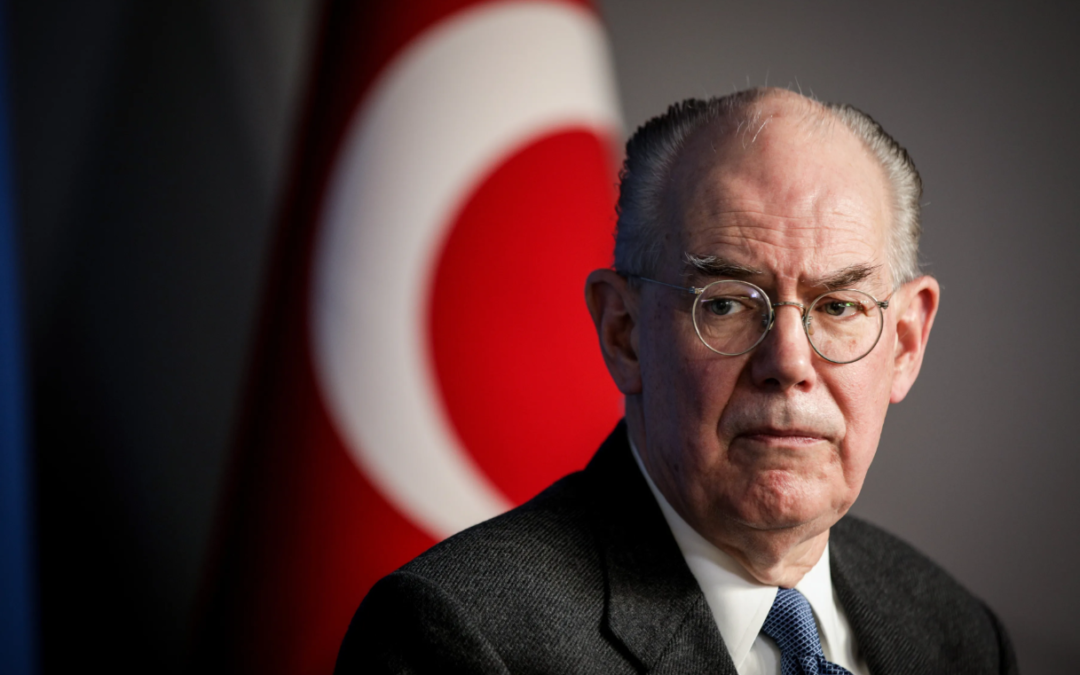
John Mearsheimer claims to be a realist.
With such a designation, one would expect his arguments to closely reflect observable reality. The problem is that his version of reality does not align with the full scope of relevant evidence. In short, his claims exceed what the evidence can reasonably support.
John J. Mearsheimer is a professor of political science at the University of Chicago. He previously served briefly as a junior commissioned officer in the U.S. Air Force, reaching the rank of Captain (O-3), an early-career grade that does not involve senior command or strategic planning authority. After completing his doctoral training, he worked in academic and fellowship roles adjacent to Washington’s foreign-policy discourse before beginning his academic career.
While Mearsheimer is an established academic theorist associated with structural realism, his analysis of Ukraine relies on abstract structural assumptions that omit critical historical, political, and evidentiary realities specific to Ukraine and Russia, leading his conclusions to exceed the scope of the evidence.
Today, Mearsheimer remains active through policy talks, European forums, and online interviews, presenting a realist account of the war in Ukraine centered on NATO expansion. Although he represents no government, his framing is frequently echoed by Russian state-aligned media. Regardless of intent, this framing functions to normalize and legitimize Kremlin narratives by shifting primary responsibility for Russia’s invasion of Ukraine away from Russian agency and toward Western policy decisions.
Assessing John J. Mearsheimer on Ukraine
(Logic + Evidence Audit)
This analysis reviews the key timelines, events, and statements needed to accurately describe the reality of Russia’s attack on Ukraine. Examining the broader historical context shows that Russian aggression was not caused by Western policy choices, but reflects long-standing strategic intent. Misattributing blame rewrites causality, misleads the public, and risks distorting policy decisions. A realistic assessment requires grounding conclusions in the full scope of available evidence.
Accuracy markers (claim-level)
- ⬤ Foundational constraint (required factual baseline)
- 🟢 Sound / contextually true (accurate, complete, and safe in context)
- 🟡 Partly true / caution (correct as stated, but incomplete or context-sensitive)
- 🟠 False or misleading (facts are cherry-picked or used out of context)
- 🔴 False framing / dangerous misuse (cause-and-effect is reversed or distorted)
Confidence Markers
Legend for confidence markers: Dots shown next to a color marker indicate the strength of the evidence supporting that evaluation.
Legend:
🟢 sound 🟡 caution 🟠 misleading risk |
●●● high confidence ●●○ moderate confidence ●○○ low confidence
Summary assessment (overall)
The summary assessment reflects the aggregate pattern of the claim-level markers above.
- Factual accuracy: mixed 🟡
- Misuse risk (true-but-dangerous leverage): very high 🔴
- Ethical alignment (agency + accountability): low 🔴
- System-health effect (Europe + global norms): negative 🔴
Key warning signs (how the argument misleads)
- 🔴 Agency deflection: shifts primary responsibility from Russia’s decision to invade toward Western policy choices.
- 🟠 False equivalence: treats “Western miscalculation” as comparable to territorial conquest by force.
- 🟠 Selective literalism: elevates NATO statements/aspirations while minimizing Russia’s long-running coercive posture toward Ukraine.
- 🔴 Scope exceedance: broad causal claims resting on a narrow set of inputs (“NATO expansion explains it”), ignoring contrary evidence.
- 🟠 Strawman risk: re-casts defensive preparation as “provocation,” then attacks the re-cast position.
Reality check (what must be kept in view)
- ⬤ Russian agency is primary:
Russia’s invasion is a deliberate state act; causality cannot be responsibly modeled without centering Russian decision-making and objectives, as reflected in the UN General Assembly’s determination of aggression and Russia’s own official statements [12] [11]. - ⬤ NATO context is real but not causal:
NATO’s 2008 Bucharest language (“will become members”) exists, but it does not erase prior, persistent Russian pressure on Ukraine’s sovereignty or establish legal or strategic causation for invasion [5] [1] [3] - ⬤ Coercion predates NATO 2008:
Long before 2008, Russia–Ukraine relations were repeatedly strained by disputes over Crimea, Sevastopol, and basing rights—early indicators of coercive intent and contested sovereignty [7] [9] [10]. - ⬤ Systematic violence against civilians is documented:
Russia’s conduct in Ukraine includes widespread and systematic targeting of civilians—unlawful detention, torture, rape, forced transfer of children, and attacks on homes, hospitals, and schools—documented by the UN, OSCE, OHCHR, and the ICC. These acts constitute terror-based coercion and cannot be explained or justified by NATO policy debates [17] [18] [19] [20].
What Mearsheimer gets partly right (narrow scope)
- 🟢 NATO expansion debates mattered: NATO enlargement and security discussions were real and salient in post–Cold War Europe, including the 2008 Bucharest Declaration.
- 🟢 Great-power security dilemmas exist: Major powers do react to perceived shifts in regional power balances, and miscalculation can increase risk.
- 🟢 Western policy was not cost-free: Some Western decisions underestimated Russia’s willingness to use force, though this does not establish causation or justification.
Why “partly true” can be dangerous
- 🟠 True-but-dangerous leverage: correct facts (e.g., NATO expansion debates) are used to “sell” an overall causal story that minimizes Russian agency and normalizes conquest logic.
- 🔴 Outcome effect: audiences may walk away concluding “Russia isn’t primarily responsible,” which tracks Kremlin messaging even when intent is not claimed.
Russia’s long-term posture toward Ukraine (timeline highlights)
- 1992–1995: Crimea autonomy crisis and pro-Russia political agitation; Russian political claims appear early in the post-Soviet period. [7] [8]
- 1993: Russian parliament claims Sevastopol; Ukraine raises the issue internationally; the UN Security Council President states the decree is “without effect.” [10]
- 1997: Russia and Ukraine sign the Friendship Treaty recognizing borders/territorial integrity; Black Sea Fleet basing terms are set. [1] [2]
- 2003: Tuzla Island crisis (causeway incident) triggers fears of territorial coercion. [3] [4]
- Apr 25, 2005 (context signal): Putin calls USSR collapse a “major geopolitical disaster,” a marker of restorationist grievance politics. [11]
- Apr 3, 2008: NATO Bucharest Declaration states Ukraine and Georgia “will become members.” [5]
- Apr 4, 2008: Kremlin record confirms Putin’s conversation with Bush at the summit and discussion of an upcoming bilateral. [6]
- Feb 22, 2014: Following months of mass protests centered on Kyiv’s Maidan Nezalezhnosti (Independence Square), Ukrainian president Viktor Yanukovych fled the country after losing political and security support. Russia characterizes these events as a Western-backed coup; Ukraine and most Western governments characterize them as a popular uprising following Yanukovych’s reversal on EU integration. What is not disputed is that Yanukovych departed Ukraine and that Russia moved shortly thereafter to seize Crimea.
Update — 2026-01-14
Domestic political alignment (2004–2010):
Paul Manafort advised Viktor Yanukovych and his Party of Regions through the period leading to Yanukovych’s 2010 election victory. 🟢 ●●●
External signaling (2008):
NATO’s Bucharest Summit declaration stated that Ukraine (and Georgia) “will become members of NATO.” 🟢 ●●●
Policy reversal & public response (late 2013):
Yanukovych suspended Ukraine’s EU association path, helping trigger the mass protests that became the Maidan / Revolution of Dignity. 🟢 ●●●
Regime collapse (22 Feb 2014):
Yanukovych fled Ukraine and ultimately departed to Russia. 🟢 ●●●
Interpretive implication:
This sequence shows that multiple causal tracks were already active before NATO-centric explanations became prominent, making single-cause accounts incomplete. 🟡 ●●○
- Interpretive framing (18 Aug 2014): John Mearsheimer published “Why the Ukraine Crisis Is the West’s Fault,” arguing that Western policy—especially NATO and EU expansion—was central to the crisis. 🟡 ●●●
- 2022: UN General Assembly adopts ES-11/1 “Aggression against Ukraine,” establishing the baseline international record and legal framing for the invasion. [12]
Public activity (why this spreads)
- Mearsheimer remains active via high-visibility talks and interviews (including listed appearances on his own site). [15]
- He continues to appear in major policy/media ecosystems; recent European talks are republished and reused as persuasive references in policy and media contexts. [16]
- His arguments are frequently amplified by state-aligned Russian messaging ecosystems (effect-based observation; not an intent claim).
Example of narrative circulation (primary source)
This video is provided as a primary-source example of public dissemination. Its inclusion documents how the argument is circulated and reused; it does not confer analytical or evidentiary authority.
Open the video on YouTube
Update — 2026-01-14
John Mearsheimer’s talk was not an official meeting of the European Parliament, not a plenary session, and not a parliamentary committee hearing. 🟢 ●●●
The event was organized by the Patriots for Europe Foundation. 🟢 ●●●
The meeting was held inside a European Parliament building. 🟡 ●●●
This setting may have given some viewers the impression that Mearsheimer was addressing the European Parliament itself. 🟠 ●●○
In his opening remarks, Mearsheimer stated that it was “an honour to be here today to speak at the European Parliament.” 🟡 ●●●
While literally accurate in terms of location, the event did not constitute an address to the European Parliament as an institution. 🟢 ●●●
It did not involve formal parliamentary debate or policy deliberation. 🟢 ●●●
Conflating venue with institutional authority risks giving readers a misleading impression of the event’s official status. 🟠 ●●○
Legend:
🟢 sound 🟡 caution 🟠 misleading risk |
●●● high confidence ●●○ moderate confidence ●○○ low confidence
Bottom line (synthesis)
- Mearsheimer’s model sounds coherent because it uses some true facts. The failure is structural: it repeatedly treats NATO as the prime mover and demotes Russia’s agency, objectives, and long-running coercive posture—producing a misleading causal story with high propaganda utility.
This assessment reflects the best available evidence at the time of writing and may be revised if new, materially relevant information emerges.
References
- Treaty on Friendship, Cooperation, and Partnership (UN registration / treaty text reference). UNTS PDF Legal analysis overview
- 1997 Black Sea Fleet Partition Treaty summary. Overview (For deeper: see ETH Zurich CSS analysis on basing terms.) ETH/CSS PDF
- Tuzla Island conflict summary. Overview
- CEPA analysis: Tuzla as early “assault” indicator. CEPA (2023)
- NATO official text: Bucharest Summit Declaration (Apr 3, 2008). NATO
- Kremlin record of Putin’s brief talk with Bush at the Bucharest summit (Apr 4, 2008). Kremlin.ru
- Crimea autonomy crisis context (1992–1995) overview. Overview
- Geneva Academy report noting early Russian parliamentary questioning of Crimea’s transfer. PDF
- UN Digital Library record of the General Assembly resolution “Aggression against Ukraine” (primary UN record; includes PDF access). UN Digital Library record
- UN Security Council Repertoire (primary UN summary): 1993 Ukraine complaint regarding the Russian parliament decree on Sevastopol and the Council President’s statement that it is “without effect.” UNSC Repertoire (1993–1994)
- Putin 2005 Address (official transcript): “collapse of the Soviet Union was a major geopolitical disaster.” Kremlin.ru transcript
- UN General Assembly resolution ES-11/1 “Aggression against Ukraine” (2 March 2022) (primary UN document). UN Docs: A/RES/ES-11/1
- Council on Foreign Relations entry referencing Mearsheimer’s “Why the Ukraine Crisis is the West’s Fault” (Foreign Affairs, 2014). CFR
- Primary text: John J. Mearsheimer (2014), “Why the Ukraine Crisis Is the West’s Fault” (PDF). PDF
- Mearsheimer’s self-listed public appearances (shows ongoing talk/interview cadence). Mearsheimer.com
- Public circulation example: Video of a John J. Mearsheimer talk republished by The American Conservative, originating from a Brussels / European political context. Included here solely as a record of distribution and reuse in media ecosystems, not as an authority source or endorsement.
Page link - OHCHR thematic report (27 June 2023): “Detention of civilians in the context of the armed attack by the Russian Federation against Ukraine.” OHCHR PDF
- OHCHR report (Sept 2025): “Treatment of civilians deprived of their liberty in the context of the armed attack by the Russian Federation against Ukraine” (documents widespread/systemic patterns). UN Ukraine / OHCHR PDF
- OSCE Moscow Mechanism-related document (Apr 2024) describing findings on arbitrary detention, mistreatment, torture, and extrajudicial killing of civilians as part of war strategy (institutional OSCE channel). OSCE PDF
- International Criminal Court (ICC) defendant page: Maria Alekseyevna Lvova-Belova (official ICC page; links to the Ukraine situation warrant announcement). ICC page
- UN Media (UNifeed) entry referencing ICC arrest warrants in the Ukraine situation (archived UN media record). UNifeed page
Unite America with The Centrist Party
- The Centrist News invites you to consider joining the Centrist Party. We all need to work together to heal our nation and return balance in governance and common sense for our nation and the people.
